
Indoor air quality (IAQ) is often invisible until it starts causing real problems.
Employees feel tired. Sensitive manufacturing processes fail audits. Hospitals struggle with infection control. In most cases, the root cause isn’t people or processes it’s poorly designed HVAC systems.
In India, indoor air quality needs special attention due to:
- High dust levels
- Seasonal humidity extremes
- Outdoor pollution
- Strict cleanroom and pharma regulations
That’s why experienced HVAC systems manufacturers in India focus on engineering clean, controlled air, not just temperature control.
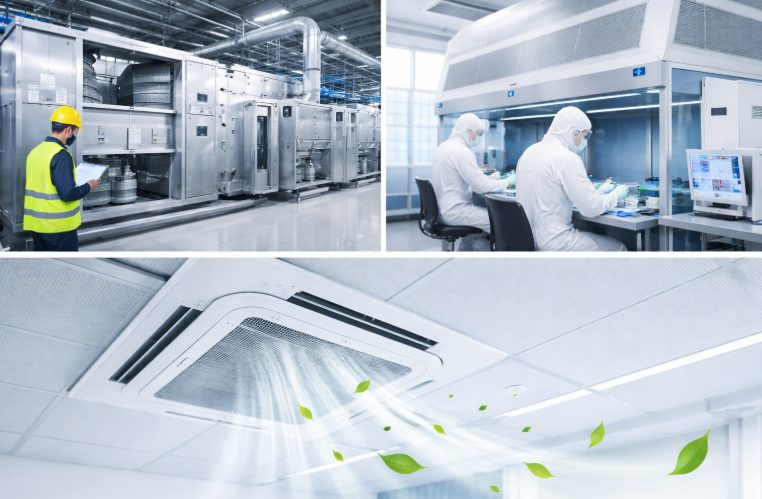
What Does “Good Indoor Air Quality” Actually Mean?
Good IAQ is about balance, not just cooling power.
Healthy indoor air means:
- Low particulate matter (dust, PM2.5, PM10)
- Controlled humidity (no mold, no static)
- Proper airflow and ventilation
- Minimal bacteria, viruses, and VOCs
- Stable temperature across all zones
According to ASHRAE, people spend nearly 90% of their time indoors, making HVAC systems one of the most critical building infrastructures.
Why HVAC Design Important?
Many buildings still rely on:
- Oversized air conditioners
- Poor duct layouts
- Basic filters
- Zero fresh air strategy
This leads to:
- Stale air circulation
- Uneven cooling
- High contamination risk
- Increased energy consumption
Modern HVAC systems especially turnkey solutions are designed to address air quality first, then comfort.
How HVAC Systems Improve Indoor Air Quality (Step by Step)
1️. Air Filtration: The Foundation of Clean Air
Filtration is where IAQ starts and often fails.
High-quality HVAC systems use multi-stage filtration, including:
- Pre-filters for coarse dust
- Fine filters for smaller particles
- HEPA filters for critical environments
Products like Gel Seal Mini Pleat HEPA Filter Modules are designed to eliminate air leakage and maintain consistent filtration efficiency.
Why this matters:
- HEPA filters remove 99.97% of particles ≥0.3 microns
- Reduces airborne contamination
- Protects both people and products
Learn more about filtration systems here: Clean Room Filters
Poor filtration and airflow design are among the most common reasons for indoor air quality failures. See how turnkey HVAC design prevents these issues
2. Air Handling Units (AHUs): The Control Center
The Air Handling Unit (AHU) is the heart of any HVAC system.
A well-designed Air Handling Unit controls:
- Filtration stages
- Temperature
- Humidity
- Fresh air mixing
- Air distribution
In cleanrooms and pharma facilities, AHUs are custom-engineered—not selected off a catalog.
Supporting components such as:
- Heat Transfer Coils
- Dampers, Diffusers & Grills
play a major role in maintaining stable and clean airflow.
3️. Ventilation & Fresh Air Management
Recirculating the same air again and again increases:
- CO₂ levels
- Odors
- Airborne contaminants
Proper HVAC systems ensure:
- Controlled fresh air intake
- Exhaust of stale air
- Balanced pressure zones
In controlled environments, ventilation works alongside:
These systems reduce cross-contamination while maintaining airflow integrity.
4️. Humidity Control: Often Ignored, Always Critical
Humidity directly impacts:
- Mold growth
- Static electricity
- Product stability
- Equipment life
Ideal indoor humidity range is 40%–60%
HVAC systems achieve this using:
- Cooling and reheat coils
- Sensors and controls
- Dedicated Dehumidifiers
This is especially important in cleanrooms, pharma, and electronics manufacturing.
5. Airflow Patterns & Distribution
Even the best filters fail if airflow is poorly designed.
Correct airflow:
- Eliminates dead zones
- Maintains pressure differentials
- Prevents contamination buildup
Systems like Laminar Air Flow units are used where unidirectional airflow is required such as sampling or sterile areas.
Specialized Equipment That Supports Indoor Air Quality
HVAC systems work alongside containment and cleanroom equipment, including:
- Biosafety Cabinets – operator & product protection
- Fume Hoods – safe chemical exhaust
- Dispensing & Sampling Booths – dust containment
- Garment Cubicles & Storage Cabinets – contamination control
Each plays a supporting role in maintaining indoor air quality.
Cleanroom HVAC: Where IAQ Is Non-Negotiable
In cleanrooms, indoor air quality directly affects:
- Product quality
- Compliance
- Audit outcomes
HVAC systems must align with:
- ISO cleanroom classifications
- GMP and FDA standards
This requires integration with:
- Clean Room Panels
- Windows, Frames & View Panels
- Advanced air filtration systems
This holistic approach is why turnkey HVAC execution delivers better results than fragmented installations.
Cleanroom air quality depends on how HVAC, filtration, airflow, and construction materials work together. View integrated cleanroom HVAC solutions
Energy Efficiency and IAQ Can Go Together
Better air quality does not mean higher energy bills.
Modern HVAC systems use:
- Optimized airflow design
- Energy-efficient motors
- Smart controls
- Heat recovery systems
According to the International Energy Agency, efficient HVAC design can reduce energy consumption by 20–40% while maintaining excellent IAQ.
Why Turnkey HVAC Projects Deliver Better IAQ?
Turnkey execution ensures:
- Unified design and execution
- Correct equipment selection
- Proper testing and commissioning
- Long-term performance reliability
This is why many industries choose HVAC systems manufacturers in India who offer complete turnkey HVAC and cleanroom solutions.
Quick Checklist to Improve Indoor Air Quality
When planning or upgrading an HVAC system, focus on:
- High-efficiency filtration (HEPA where required)
- Proper AHU sizing and zoning
- Fresh air and exhaust balance
- Humidity control strategy
- Cleanroom-compatible materials
- Professional HVAC design and validation
Final Thoughts
Indoor air quality is no longer optional it’s operationally critical.
From offices to pharmaceutical facilities, the quality of indoor air affects:
- Health
- Productivity
- Compliance
- Equipment life
- Product safety
A thoughtfully designed HVAC system, delivered as a turnkey solution by experienced HVAC systems manufacturers in India, ensures clean, controlled, and reliable indoor airevery single day.
Planning a Turnkey HVAC or Cleanroom Project?
If indoor air quality, compliance, and long-term performance matter, HVAC design cannot be an afterthought. Explore Ultrafil’s Turnkey HVAC & Cleanroom Projects
FAQs
Start with better filtration and correct airflow. Upgrading to multi-stage filters (pre + fine + HEPA where required) and fixing duct leaks/dead zones usually delivers the quickest measurable improvement in dust and particle control.
Yes in the right zones. HEPA filtration is most effective in critical areas (cleanrooms, pharma, healthcare, sensitive manufacturing) and works best when protected by pre/fine filters so it doesn’t clog too quickly.
Cooling alone doesn’t guarantee good IAQ. If your HVAC system has low fresh air intake, poor ventilation balance, or weak exhaust, CO₂ and odors build up and air starts feeling stale even when temperatures are comfortable.
A practical target is 40%–60% relative humidity for most indoor environments. Staying in this range helps reduce mold risk, supports comfort, and prevents humidity-related issues like static problems in electronics or product instability in sensitive manufacturing.
Because IAQ depends on how filtration, AHU design, airflow distribution, ventilation, and controls work together. Turnkey execution improves results by ensuring one integrated design, correct equipment selection, proper commissioning, and consistent long-term performance.