
Cleanrooms are critical environments in industries like pharmaceuticals, electronics, semiconductors, biotechnology, and medical device manufacturing where particle‑free air, controlled temperature and humidity, and stringent contamination control are non‑negotiable. At the heart of any cleanroom’s performance is the Air Handling Unit (AHU) , a system designed to condition and circulate air while maintaining cleanliness standards.
An Air Handling Unit (AHU) is a piece of HVAC equipment that:
- Filters incoming air
- Controls temperature and humidity
- Distributes conditioned air into controlled environments
In cleanrooms, AHUs must go beyond basic HVAC performance; they must handle HEPA/ULPA filters, maintain ISO cleanliness classes, and support air change rates that often exceed 20–100+ air changes per hour depending on classification.
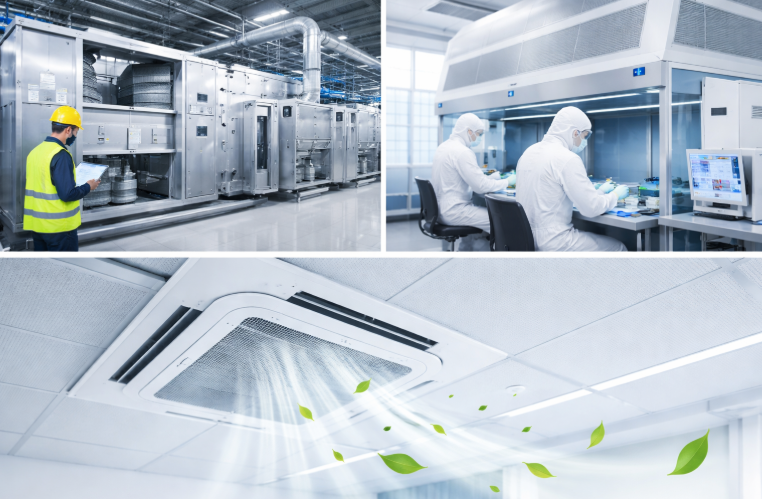
Best Practices for Cleanroom Air Handling Units (AHUs)
1. Understand Cleanroom Classification Requirements
Cleanrooms are classified by the number and size of airborne particles per cubic meter like ISO 5, ISO 6, ISO 7, etc. The more stringent the ISO class:
– Higher filtration efficiency
– Higher air change rates
– Better sealing and airflow control
2. Select High‑Efficiency Filtration Systems
Cleanroom AHUs must integrate HEPA or ULPA filters strategically:
- Pre‑filters (like G3–F8) to protect HEPA/ULPA
- Final HEPA/ULPA filters for particle removal
- HEPA filters often at H14 efficiency for critical areas
Clean room filter manufacturing unit Punjab and other filter OEMs play a key role in providing customized solutions. Choosing quality filtration ensures:
- Longer filter life
- Lower contamination risks
- Stable pressure differentials
3. Design for Balanced Airflow & Pressurization
Proper air distribution prevents cross‑contamination:
- Positive pressurization — Keeps unfiltered air from entering
- Airflow balancing — Uniform supply & return
- Diffusers & grilles — Designed for laminar or turbulent flow based on requirements
Regular testing using anemometers and smoke tests helps confirm design performance.
4. Incorporate Variable Air Volume (VAV) Controls
VAV controls help maintain:
– Stable cleanroom environment
– Reduced energy consumption
– Adaptive response to real‑time conditions
With smart BAS/EMS integration, you can optimize temperature, humidity, and airflow for efficiency and compliance.
5. Temperature & Humidity Control Are Non‑Negotiable
Cleanrooms often require:
- Temperatures between 20–24°C
- Relative humidity 40–60%
Too high humidity – microbial growth
Too low humidity – static buildup
AHUs must have proper cooling coils, heating coils, humidifiers, and dehumidification stages tailored to your process needs.
6. Ensure Easy Maintenance & Accessibility
Best practices include:
– Accessible filter housings
– Quick‑release panels
– Clear service labeling
– Scheduled preventive maintenance
HVAC filter manufacturing unit Hyderabad and HVAC filter manufacturing unit Vishakhapatnam can provide filters that are easy to replace with minimal downtime.
7. Use Quality Materials & Tight Construction
Cleanrooms must be built with:
– Non‑shedding surfaces
– Durable panels
– Sealed seams
AHUs, too, should be corrosion‑resistant with minimal leakage to maintain precise air control.
8. Deploy Airflow Monitoring & Alarm Systems
Real‑time monitoring systems for:
- Pressure differentials
- Airflow rates
- Fan performance
Alarms help operators react quickly to deviations before cleanroom processes are compromised.
9. Perform Commissioning & Validation
Before starting operations:
- Validate that AHU meets design performance
- Conduct DOP/PAO testing
- Measure particle counts and airflow patterns
This step aligns AHU performance with regulatory compliance and cleanroom certification.
10. Train Operations & Maintenance Staff
Training should cover:
- AHU basics
- Filter replacement
- Troubleshooting alarms
- Documenting maintenance logs
A well‑trained team ensures high uptime and reliable cleanroom conditions.
In Top 10 AHU Manufacturers in India
- Voltas Ltd – Established HVAC solutions provider
- Blue Star Ltd – Known for industrial AHUs
- Carrier India – Advanced AHU systems
- Trane India – High‑end HVAC integration
- Thermax Ltd – Industrial HVAC & AHUs
- Godrej & Boyce – AHUs with custom features
- AHU Manufacturers Hyderabad – Local OEMs serving southern India
- Cleanroom Systems India – Specialty & custom AHU designs
- Ultrafil India – Cleanroom AHUs & filters
- Precision Air Systems – Mid‑range AHU solutions
Choosing the Right Manufacturer
When selecting a manufacturer, consider:
- ISO cleanroom compliance experience
- Customized solutions vs standard units
- After‑sales support & spare parts availability
- Local filter manufacturing unit partners
- Energy‑efficient designs
Linking with local filter suppliers like clean room filter manufacturing unit Punjab, HVAC filter manufacturing unit Hyderabad, and HVAC filter manufacturing unit Vishakhapatnam helps reduce lead times and logistics costs.
Conclusion
Cleanroom AHUs are not just HVAC systems, they are precision air management solutions that dictate cleanliness, compliance, and process stability. Following best practices from selecting the right air handling unit manufacturers in India to integrating quality filters from HVAC filter manufacturing units in Hyderabad, Vishakhapatnam, and Punjab ensures reliable operation and superior cleanroom performance.
FAQs
Typically every 6–12 months, but frequency depends on usage and pressure drops.
Yes with VFDs, variable air volume (VAV), and optimized controls.
Unbalanced airflow can cause contamination risks and non‑compliance with standards.